Specialized ADHD Care
Offering expert assessment and treatment for children, teens, and adults through a specialized approach grounded in neuroscience, current research, and evidence-based practice. Our clinic has a subspecialty in identifying ADHD in individuals with high intellectual ability, where symptoms are often overlooked or misdiagnosed.
Assessment & Treatment for ADHD & Related Disorders

All patients begin with a comprehensive evaluation and treatment for attention and related problems which may be accompanied by various difficulties that undermine success in school, college, grad school, employment, social relationships and/or family life.
These difficulties may include the following listed below:
Attention, memory, and motivation
Academic, occupational, and social underachievement
Anxiety disorders
Asperger’s Syndrome or Autism Spectrum Disorder (Level 1)
Emotional regulation difficulties (quick to frustration/irritability)
Rejection sensitivity
Depressive disorders
Obsessive-Compulsive Disorders
Parenting and family conflict
Sleep and awakening difficulties
Alcohol and drug use problems
Our Approach
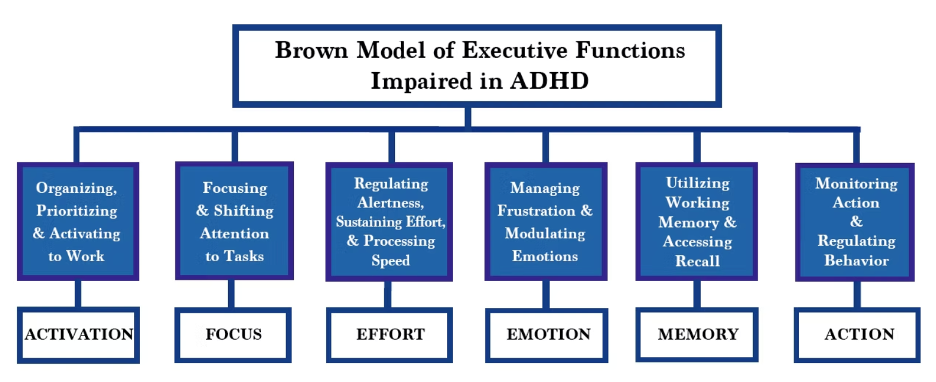
Modeled after my mentor and a world renowned ADHD expert, Thomas E. Brown, PhD, we use an understanding of ADHD symptoms as a result of a developmental impairment of the brain’s executive functioning, or self-management system.
From more than 25 years of clinical interviews and research with children, adolescents and adults who have ADHD, Dr. Brown developed an expanded model of to describe the complex cognitive functions impaired in ADHD. This model describes executive functions, the cognitive management system of the human brain.
While this model shows 6 separate clusters, these functions continually work together, usually rapidly and unconsciously, to help individuals manage many tasks of daily life.
The functions appear in basic forms in young children and gradually become more complex as the brain matures throughout childhood, adolescence and early adulthood.
It is important to recognized that everyone has occasional impairments in their executive functions, but individuals with ADHD experience much more difficulty in the development and use of these functions than do most others of the same age and developmental level.
They may have chronic difficulty with ADHD symptoms in most areas of life, but when it comes to a few special interests like playing sports or video games, doing art or building Lego constructions, their ADHD symptoms are absent or hard to notice.
This phenomenon of “can do it here, but not most anyplace else” makes it appear it that ADHD is a simple problem of lacking willpower; it isn’t. These impairments of executive functions are usually due to inherited problems in the chemistry of the brain’s management system.